

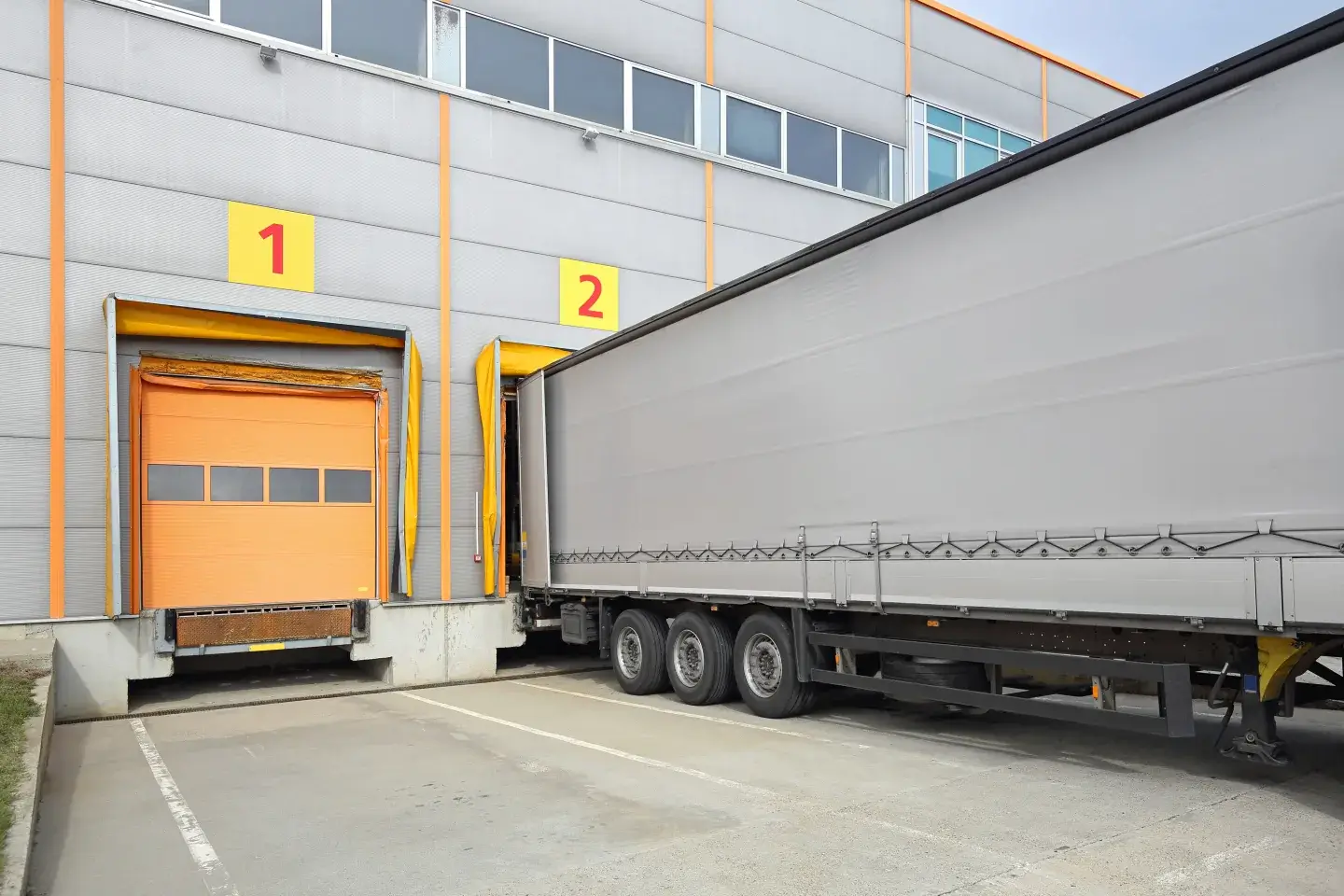
Back a trailer into your loading dock and four things stand between the air inside your warehouse and whatever the weather is doing outside: the dock seal or shelter, the bumpers, the leveler, and the dock door itself. If any one of those leaves a gap, conditioned air pours out and unconditioned air pushes in for as long as the trailer sits there.
This post walks around a docked trailer, names each gap where energy loss happens, and explains how loading dock seals, shelters, bumpers, and levelers close those openings. If you run a dock in the Wiregrass area, most of this you can check yourself with a flashlight and a few minutes.
Where Air Gets Past a Docked Trailer
Rotary Products’ seal sizing chart covers standard dock door openings from 8 to 10 feet wide and 8 to 10 feet tall. When a trailer backs in, every inch of contact between the trailer body and the building either blocks airflow or lets it through. The gaps fall into a few predictable places:
- The sides, between the trailer and the door frame
- The head (top), where the trailer roof meets or misses the head pad or head curtain
- The leveler pit, including open space on either side of the dock leveler and behind its rear hinge
- The bottom corners, where the side pads end and the dock bumpers begin
A study by Pacific Northwest National Laboratory estimated that a dock door with no seal allows about 783 cubic feet per minute (cfm) of air leakage. Field testing for the California Energy Commission dock seal report found the actual baseline is worse: physical measurements of typical crack openings pointed to a calculated leakage rate of about 2,200 cfm. When installed dock seals (about two to three years old and in fair condition) were tested at big-box retail warehouses in northern California, the average was 416 cfm at 4 Pa building pressure.
That is a large reduction, but 416 cfm is still a lot of air moving through a single dock position every minute. The same report found something else worth knowing. A visible gap appeared on either side of the dock leveler platform, even with the truck bumper flush against the loading dock. When those leveler side gaps were sealed, air leakage at the same test pressure decreased by over 50 percent.
What a Dock Seal or Shelter Closes at the Sides and Top
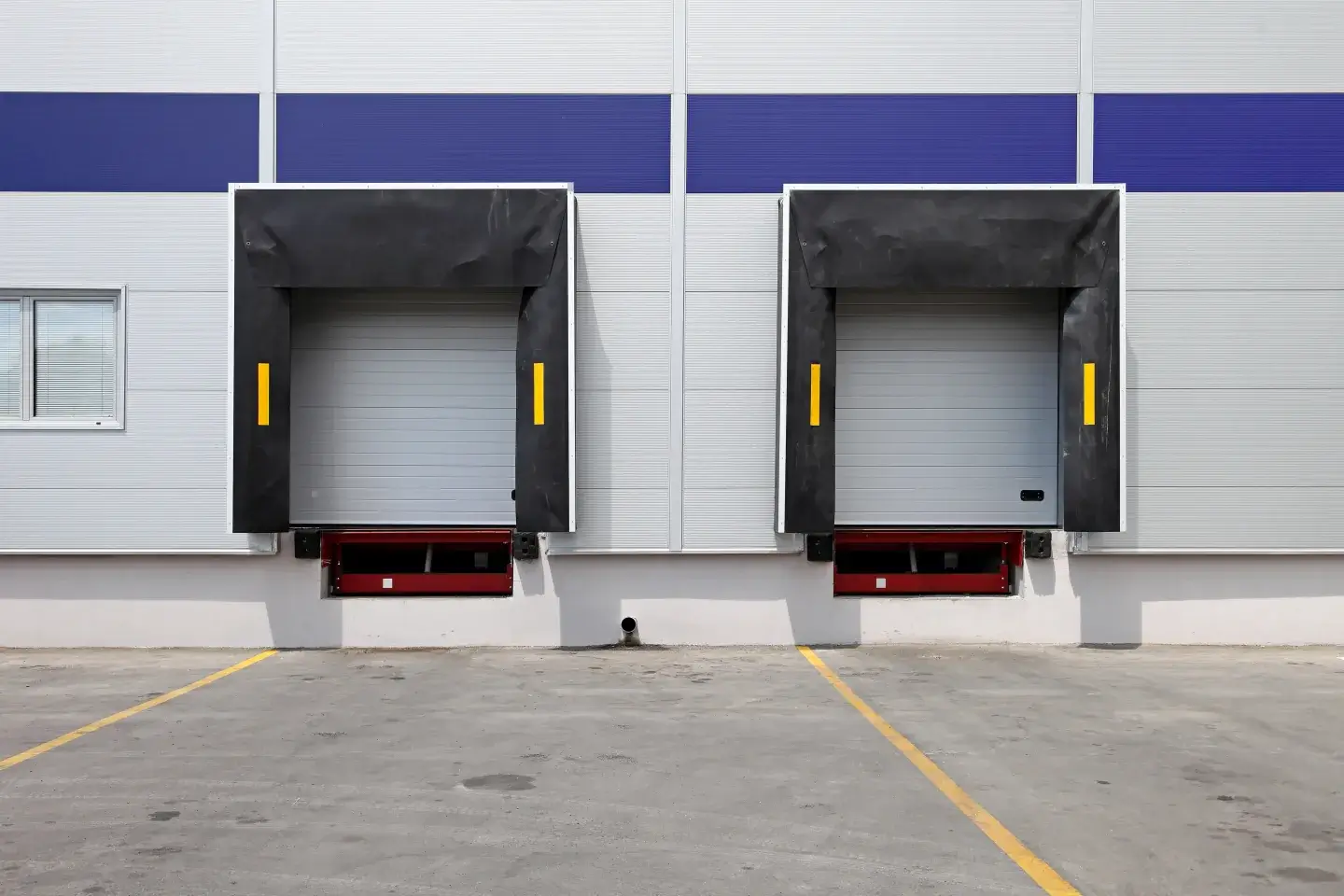
A compression dock seal presses foam side pads and a head pad against the back of the trailer when it docks. Rotary Products describes its compression seals as “designed to provide an efficient air seal between the truck trailer and the indoor warehouse area” (Rotary Products, Compression Dock Seals). Rotary’s compression design includes ventilation holes and vent pockets that let air escape fast as the pads compress, then the foam recovers when the trailer pulls away.
A loading dock shelter works differently. Its side curtains seal against the outside of the trailer rather than compressing against the back, giving full access to the trailer opening for forklifts and wide loads. Both dock seals and shelters close the same gap areas at the sides and top, but the fit, the durability under daily use, and the level of trailer access differ.
If you are deciding between the two, our post on dock seals vs. shelters covers the comparison in detail.
Dock Bumpers Set How Hard the Seal Squeezes
Dock bumpers provide dock protection and set the stopping point for the trailer. That stopping point controls how far the seal compresses. Rotary Products states it directly: “Maximum compression by docked vehicles is controlled by dock bumpers.”
The sizing rule from Rotary is bumper projection plus 4 to 5 inches. Their compression seals have header pad projections from 8 to 21 inches in 1-inch steps, and Rotary bases its standard size recommendations on a 46 to 50 inch dock height.
A seal compressed too far wears out faster and the foam loses its ability to spring back. A seal that barely touches the trailer leaves open gaps along the sides. When bumpers wear down, the trailer can push farther into the seal than it was sized for. For refrigerated dock doors, Rotary recommends 4.5-inch or 6-inch thick, extra-length, one-piece bumpers to complete the seal between the truck and the dock.
Leveler Gaps Are the Easy Ones to Miss
Pit levelers bridge the gap between the dock floor and the trailer bed so forklifts can cross to load and unload. But the leveler platform does not fill its entire pit. Gaps remain along the sides and behind the rear hinge, and those openings connect directly to the space under the dock.
Those gaps matter more than most people expect. The California Energy Commission field testing showed that sealing just the gaps on the sides of the leveler reduced air leakage by over 50 percent at a test dock that already had dock seals in place. At that dock, the leveler side gaps carried more than half of the air that was still getting through.
If you are sizing or replacing a dock leveler, our guide on how to choose a dock leveler covers types, capacities, and what to match to your operation.
What Wear Does to a Dock Seal’s Performance
A dock seal takes a hit every time a trailer backs in and pulls away. The foam gets compressed, the vinyl cover scrapes against the trailer body, and the head pad flexes through its full range. Over months of daily use, foam loses its spring. Tears in the cover expose the foam to rain, UV light, and temperature swings, all of which speed the breakdown.
The CEC field tests noted that the seals tested were in “fair condition, but not new, likely two to three years old.” Even at that age they still reduced leakage compared to an open dock door. The U.S. Department of Energy’s summary of ASHRAE 90.1-2016 includes a simple inspection point for loading dock weatherseals: “Ensure that the seals are in good condition.”
Signs to watch: foam that stays flat after the trailer pulls away, visible tears in the cover, a head pad that no longer reaches the top of the trailer, and daylight around the edges when a trailer is docked. Our dock seals vs. shelters post includes notes on maintaining both types.
Doors and Curtains Beyond the Dock
Seals, shelters, bumpers, and levelers handle the outside face of the dock opening. But most buildings also have a doorway between the dock area and the climate-controlled warehouse or production floor. Every time a forklift rolls through or someone walks across, conditioned air moves between the two spaces.
PVC strip doors are one common fix for temperature control at that interior boundary. Rotary Products describes its strip doors as “used in areas where traffic through a doorway creates energy loss” and as aiding in “efficient passage, climate control, and noise reduction.”
For higher-traffic door openings, a high-speed door like the Raynor RapidCoil opens and closes fast enough to limit air exchange. Raynor states that “by combining a tight sealing door with high-speed operation, a more energy-efficient environment is created, which can decrease operating costs in manufacturing environments” (Raynor, RapidCoil). Southern Door Company carries both Rotary strip doors and Raynor high-speed doors.
What the Codes Say About Loading Dock Weatherseals
The 2016 edition of ASHRAE Standard 90.1 calls for cargo doors and loading dock doors to have weatherseals “in climate zones 0 and 4-8” to restrict infiltration when vehicles are parked at the dock (U.S. Department of Energy, ASHRAE 90.1-2016 Envelope). Dothan sits in a hot-humid climate zone, outside that range under the 2016 edition. Whether dock weatherseals are required at your facility depends on which edition of the energy code your local jurisdiction has adopted. Check with your building official if you need a definitive answer.
Codes aside, energy efficiency at your facility’s loading dock starts with closing the gaps. Summer heat in the Wiregrass area keeps cooling systems running hard, and an unsealed dock door adds to that load. For more about door insulation and U-factor, see our earlier post on commercial door energy efficiency.
A Walk-Around Check for Your Loading Dock
You can check most of these from outside with a trailer docked:
- Look for daylight between the seal pads and the trailer from either side. If you can see inside the warehouse, air is getting through.
- Look at the head pad or head curtain above the trailer. Is it making contact across the full width, or is there a visible gap?
- Check the foam on the side pads. Does it spring back when the trailer pulls away, or does it stay flat?
- Look for tears, rips, or missing sections in the seal cover material.
- Walk inside and check the leveler pit. Are there open gaps along the sides or behind the rear hinge?
- Check the dock bumpers for wear. If they are compressed, cracked, or shortened, the trailer may push too far into the seal.
- Look at the floor near the loading dock door for water, dust, or pest evidence that signals air and moisture are getting in.
For a broader look at dock conditions and loading dock safety, our loading dock safety guide covers additional items to check.
Frequently Asked Questions
Do Loading Dock Seals Save Energy?
Yes. The California Energy Commission dock seal report put the calculated baseline for a dock door with no seal at about 2,200 cfm, while field tests of installed dock seals at California big-box retail warehouses averaged 416 cfm at 4 Pa building pressure. The exact savings at your facility depend on your climate, the number of dock positions, how long trailers sit docked each day, whether you run cold storage or standard operations, and the condition of your seals. Loading dock seals and shelters reduce energy loss through the dock opening and lower the load on your HVAC system.
Where Does Most Air Leak at a Loading Dock?
Air gets through at the side and top gaps around the trailer (which dock seals and shelters close) and at the gaps beside and behind the dock leveler. The CEC study found that sealing the leveler side gaps alone cut air leakage by over 50 percent at a test dock that already had dock seals installed.
Is a Dock Seal or a Dock Shelter Better for Energy?
A compression seal presses against the back of the trailer, and Rotary Products describes its dock seals as offering “a tight seal for insulation.” A dock shelter gives full access to the trailer opening, which works better for wide loads and forklift traffic that needs the full opening. Rotary Products puts it this way: “A truck shelter seals against the outside of a truck at the loading dock and a dock seal compresses against the back of a truck when loading and unloading freight” (Rotary Products, Truck Shelters). The right choice depends on your opening size, trailer mix, and how you use the dock. Our dock seals vs. shelters post covers the full comparison.
How Do I Know My Dock Seals Need Replacing?
Look for foam that no longer springs back, tears or holes in the vinyl cover, visible daylight around the trailer when it is docked, and a head pad that does not reach the top of the trailer. If the dock bumpers have worn down, the trailer can over-compress the seal even when the seal itself still has life in it. Any of those conditions can let conditioned air leave your building and let outside air, dust, and pests in.
Get a Dock Assessment
Southern Door Company carries the full Rotary Products dock equipment line, including dock seals, shelters, and bumpers, and has served the Wiregrass area since 1992. If your dock is leaking air and driving up energy costs, call us at (334) 792-0962 or contact us to set up a free consultation. We will look at your dock, check the seals and dock levelers, and recommend what fits your building, your trailer fleet, and your budget.